Welcome to Project Fathom
Project Fathom is a unique collaboration of scientists with extensive expertise in orca biology, behaviour and acoustics who will use deep learning methods to gain insights into orca communication. This project is focused on four generations of the Northern Resident orca of British Columbia, Canada. With over 130 years of combined orca research experience and data, the potential for breakthroughs in characterizing how orca vocal exchanges are structured is significant.
Scientific investigation into non-human communication is making huge strides in recent years due to deep learning methods. Artificial Intelligence is exponentially more sensitive than the human ear to the subtle patterns in animal communication where information is being transmitted. It is these subtleties that are the key to unlocking what non-humans are saying. We are learning, for example, that some animals use names for each other, their communication exhibit’s structure similar to human language and they appear to be using symbols.
Our resources
OrcaLab, on Hanson Island, British Columbia has monitored, observed and recorded orca since the 1970s resulting in extensive acoustic recordings of tens of millions of orca calls, exactly what is required by deep learning to make significant discoveries into how orca communicate.
Additionally, this project will use extensive annotated recordings of two captive Northern Resident orca, Orky and Corky 1977-1982, as well as recordings and behaviour notes made from small boats 1979-1995. As well, decades of recordings made by the Bere Point Research Station will be used. Beginning in the summer of 2026, Project Fathom will also collect additional enhanced behavioural and environmental context of the ongoing OrcaLab and Project Fathom recordings as the Northern Resident orca clans gather in the region during the summer/fall (Fig 1).
*A Raincoast Research Society Initiative. Raincoast Research is a registered Canadian charity. This is NOT Raincoast Conservation Foundation, a separate BC charity.
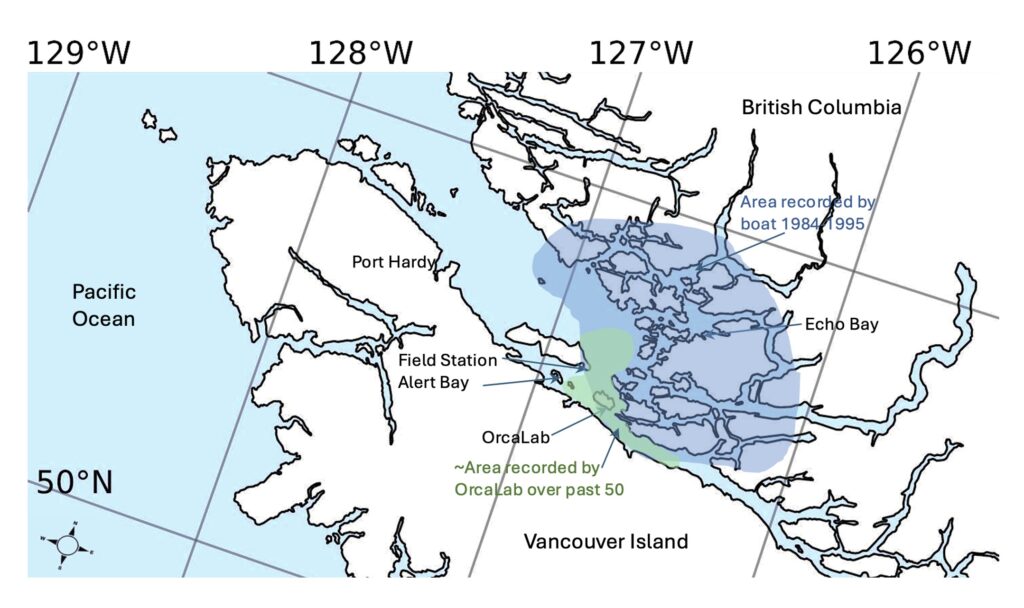
Figure 1. The wild orca recordings used by Project Fathom are primarily from this region between northeastern Vancouver Island and the mainland of British Columbia.
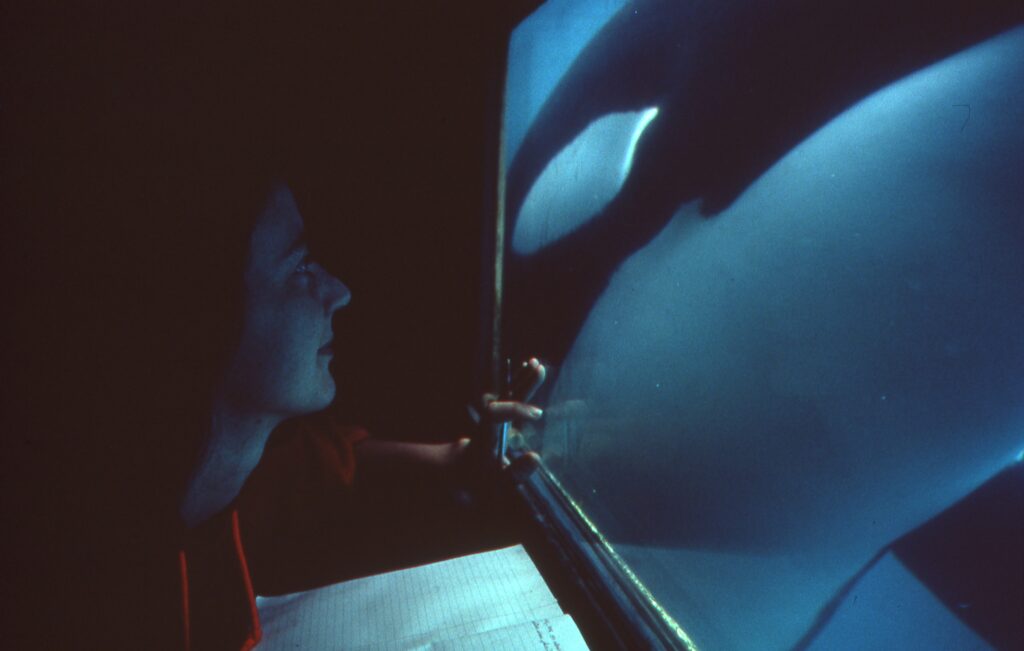
Taking notes on Corky’s behaviour and sound in an intensive study spanning 1977-1982 through the birth of two of her babies.
What do we expect to learn?
Given the depth of experience of this team and the rapid advances in deep learning research methods we can’t place a limit on how far this project may advance our understanding of orca language. However, it is certain the project will open an entirely new world of understanding of orca protocols, what is important to them, our impact on them, in short and what matters to them.
Human and orca brains share a structural complexity essential for sophisticated societies and cultural transfer of knowledge and language. However, we live in very different worlds. Orca depend on sound to survive in their ocean home. They “see” with sound. Their ear-brain connections are so much more sophisticated than ours, we can’t know how they experience their calls. Therefore, we cannot easily expect to “decode” orca sounds into something like words.
The human/orca relationship has swung widely from Indigenous respect as family members, government sanctioned killing, fraught relations with fishers, capture by the entertainment industry, tourism and now detailed understanding of their social structure and lineages.
Questions abound. Who are they? Why this large brain? What do they perceive? What is important to them? What do they talk about it? What type of information is transmitted between them? Do they have a language? How is it constructed? Are there structural parallels with human language? How do they interpret their world? What is their response to our behaviour?
Better understanding will lead to respect for their protocols, becoming better neighbours and safeguarding their survival.
Project Fathom is building on the enormous body of work by many researchers over the past 50 years. In addition to OrcaLab’s work, five generations of orca lineage is known for every orca in the study region. Our team members and collaborators are part of this work.
For decades we’ve listened and watched, kept notes, documented family trees and dialects, marked the changes of the seasons, when fish arrive, when boats arrive, when salmon runs fail, when clans converge, when something shifts in the social fabric. But the OrcaLab archive is more than this, it is tens of thousands of hours of continuous sound and context, a lifetime of conversations that no human ear, or even a team of ears, can fully contemplate, compare, and revisit across years. If we want to understand patterns that persist, patterns that change, and patterns that only appear when we step back far enough, we need tools that can listen with patience and consistency at the OrcaLab scale, without losing the nuance that matters.
The technical description of what we are planning is simply building a careful, trustworthy “listening instrument.” First, we must reliably find the whales’ voices in the sea’s noise, then understand the acoustic building blacks used to create their calls. We will map what we find into a repertoire that is rich enough to hold dialect, variation, and the in-between sounds no one has named yet. Only then can we ask the questions that brought us here, about exchanges, turn-taking, context, and change, while staying grounded in what we can verify with expert review and add further context in the upcoming season of field observation. These methods are the means to keep the whales’ world intact as we scale up our ability to listen.
Through this work humanity benefits, receiving insight from a large-brained, cultural animal that has been talking for at least 15 million years compared to our 100,000 years. Orca will benefit from our nuanced understanding of our impact on them.
Our Methods
The first step is to train learning models to distinguish orca vocalizations from marine background noise and other confounds. We will begin with a two-stage detection pipeline: a lightweight, high recall detector will scan the historical data to propose candidate vocalization regions, and a higher-capacity transformer-based confirmer will verify these candidates with high precision. This design keeps computation tractable at OrcaLab scale while producing accurate temporal boundaries needed for downstream analyses. Performance will be evaluated using precision, recall, PR-AUC, false positives per hour at fixed-recall operation points, and calibration to ensure confidence thresholds transfer across spatiotemporal boundaries.
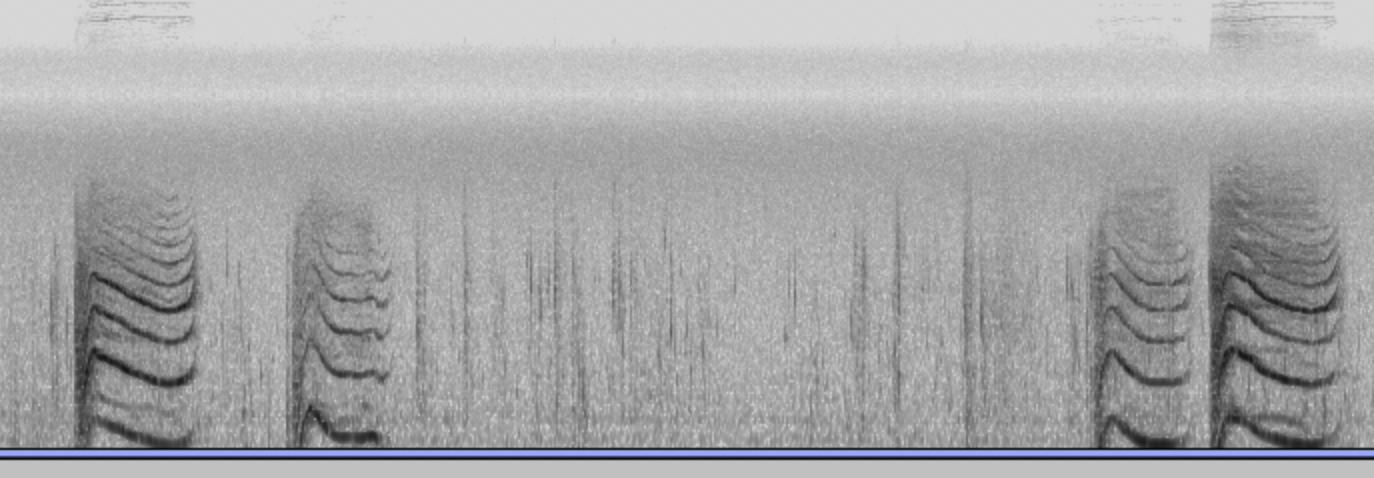
Spectrogram of A clan orca exchange
Using the validated encoder, we will then characterize the Northern Resident vocalizations in a data-driven manner. Rather than defining a fixed set of discrete call classes, we will construct a repertoire atlas that represents vocalizations as regions along a continuous manifold, allowing both discrete-like call families and graded transitions between variants. We will identify stable, recurrent regions using density-based discovery and robustness checks, and we will attach interpretable acoustic descriptors. Expert review will be applied primarily to cluster exemplars and ambiguous regions to assess coherence and to flag non-orca or nuisance clusters. This approach is explicitly designed to re-examine catalog boundaries and capture micro-variation that may be missed by human-ear categorization.
Once the repertoire atlas is established, we will analyze patterns of vocal exchange across time, matrilines, and context. In this proposal, “Natural Language Processing” and “large language models” refer to sequence models and statistical probes applied to sequences of vocal events, not to direct translation into human words. We will represent encounters as sequences of atlas assignments and / or continuous embeddings, retaining “unstructured” events explicitly rather than discarding them as noise. We will then test for quantitative signatures of structure, such as turn-taking, non-random sequential constraints, and context-conditioned predictability. This will be done by comparing sequence-model performance and compression / structure metrics to matched controls. These analyses yield falsifiable, interpretable results about how communication structure varies with social and environmental conditions.
Beginning in 2026, we will further increase density and quality of behavioural and environmental context through an additional land-based site and targeted vessel observations. OrcaLab will not participate in the boat based observations but will continue to contribute its historic and current recordings and ongoing land based observations.
Most intriguing, large language models can be used to create high-dimensional models of human languages that resemble constellations. Each word is a star placed near other words that are used together. Remarkably, all human languages generate very similar shaped models. When the English language model is transposed onto the Chinese model, for example, they are not only similar shapes, but the placement of similar concepts and words match. The word “dog” appears in approximately the same place in both Chinese and English. Thus, these models allow human languages to be roughly translated. Project Fathom will attempt this with orca communication. Do overlaps exist between human and the A clan orca language models that might hint at meaning? How are our languages the same and how are they different?
Our Ethics
Project Fathom is dedicated to using only benign techniques and research tools, non-physical contact and using existing historic records. The majority of this project is land based to minimize boat noise in the study area.
Who we are
Most research on wild animals is limited to short periods of observation in the field. However, the OrcaLab data-stream and most of the researchers involved are based in the study area year-round. OrcaLab established a permanent presence in the region in the 1970s. Alexandra Morton moved into the region permanently in 1984. Jared Towers has made the region his home since he was a child. Dr. Martin Krkosek has done extensive field research in the area since 2002 on salmon, his young family is based in the study area, with a research vessel, leaving for intervals to teach at the University of Toronto.
Principle Investigators
Alexander Barnhill has been working to interface cutting edge artificial intelligence methods with northern resident orca vocalizations since 2017. He is a PhD candidate at the Pattern Recognition Lab of Friedrich-Alexander-Universität Erlangen-Nürnberg, where he has developed AI technology to aid in wildlife conservation efforts involving orcas. His work includes the creation of Finwave, an AI-powered software that uses deep learning to identify individual killer whales by their unique dorsal fin patterns and other markings, which has been instrumental in efforts to reunite an orphaned orca calf with its pod in British Columbia. The software has demonstrated over 90% accuracy in identifying Bigg’s killer whales and is being transitioned into an open-access data system.
In addition to Finwave, Barnhill has contributed to other AI projects related to orcas, including ORCA-SPY, a deep learning-based system for detecting, classifying, and localizing killer whale vocalizations. He also co-developed ORCA-WHISPER, a toolkit for generating automatic killer whale sound types using deep learning. These projects are part of his broader research focus on deep learning applied to animal linguistics. Publications list
Alexandra Morton began researching communication in whales and dolphins in 1977 at Marineland of the Pacific, near Los Angeles publishing on the correlation between calls and behaviour in captive northern resident orca, Corky and Orky. In 1984, she began a long-term study of orca communication in the Johnstone Strait and adjacent Broughton Archipelago. When this population of whales was displaced by industrial aquaculture Morton established the Salmon Coast Field Station, and published on disease transfer from farmed to wild salmon populations. In response to mounting evidence, First Nation leadership closed salmon farms in the region. Since then, wild salmon and northern resident orca have been documented increasing in the region.
Today, Morton is returning to the study of communication in orca using deep learning methods. Morton has lived in the study area for forty-one years. Morton has published several books including an account of her early orca research Listening to Whales.
Dr. Martin Krkosek is an Associate Professor and Canada Research Chair in the Department of Ecology and Evolutionary Biology at the University of Toronto. Trained in mathematical biology and marine biology, his lab conducts quantitative research in the areas of conservation biology, marine fisheries, and infectious diseases. He runs a 20-year research program on the marine ecology of juvenile salmon around the Vancouver Island area, and has also worked on herring, coral reefs, several parasites, marine mammals, and mathematical models for ecological and evolutionary theory. He serves on the editorial board of the Proceedings of the Royal Society of London B and is the co-Editor-in-Chief of the Canadian Journal of Fisheries and Aquatic Sciences. Krkosek can provide quantitative expertise, academic resources, and supervision of graduate students and postdoctoral fellows. Dr. Krkosek is based in the study area.
Research Collaborators
Dr. Paul Spong founded OrcaLab on Hanson Island in 1970 as a summer research station to study free ranging orcas after conducting orca and dolphin visual acuity research at the Vancouver Public Aquarium and after co-founding the Greenpeace “Save the Whales” movement. In 1979, OrcaLab became a year-round facility. At this time, OrcaLab became dedicated to developing benign research methods, creating a remote 6-8 hydrophone network that covered 502 km of the Johnstone Strait/Blackney Pass/Blackfish Sound area which later became part of officially designated Northern Resident Critical Habitat. This 24/7 network produces approximately 1000 hours of acoustic recordings each year. To further investigations into orca behaviours and movements throughout the area OrcaLab developed a complimentary remote camera network, including instrumented sites at the rubbing beaches within the Robson Bight Ecological Reserve. Both networks are offered as an educational outreach live to a worldwide audience. Dr Spong has been involved with many environmental issues over the years. In recognition of his work he was given the Order of British Columbia in 2022.
Helena Symonds has developed expertise in recognizing aspects of whale acoustics from species identification to understanding the different orca family dialects over the past 46 years. These skills have enabled Helena to describe and summarize in detail the daily orca movement, associations and behaviours throughout the area covered by OrcaLab’s hydrophone network. Since 1979 Helena has assisted the development of OrcaLab into the research facility it is today, encouraging and mentoring young adults from around the world each year through its volunteer program and hosting many visitors. Volunteers learn about OrcaLab’s research methods and dedication to sound conservation practices and positive attitudes to whales.
Jared Towers is leading orca researcher in the study area. Using photo-identification, Jared provides the information that keeps track of the births, deaths and lineages of several killer whale populations including A clan orca. He helps advise and direct cetacean research, conducts conservation based field research and responds to cetacean incidents such as entanglements, entrapments, and strandings using novel, minimal impact methods. Jared founded Bay Cetology Society which both Barnhill and Morton are also directors. Jared has lived in the study region for his entire life. His observations of killer whales began aboard his family’s whale watching vessel as a child. Jared will provide orca behaviour interpretation and understanding which will provide insight essential to understanding what orca are doing when they are vocalizing.
What will be gained?
In a word – insight – into these large-brained, culturally sophisticated beings that evolved some 15 million years ago. Humans, by comparison, have been around a mere 100,000 years. Orca will benefit from our increased understanding of them.